
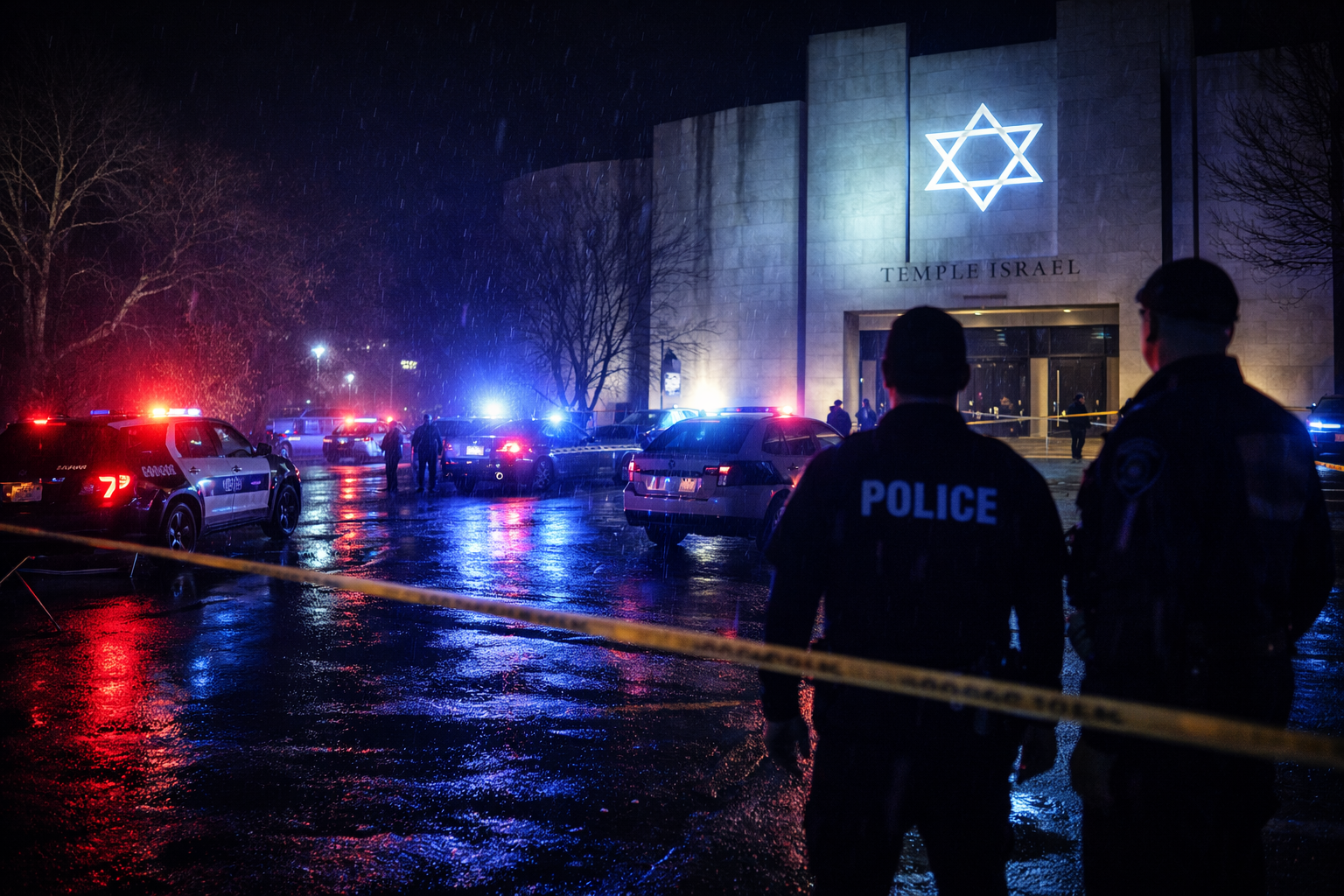
Detroit Synagogue Vehicle Attack: Suspect Shot Dead by Police
<p>A man who drove a vehicle toward Temple Israel synagogue in the Detroit area was shot and killed by police after the incident, prompting renewed security concerns among Jewish communities already operating under heightened threat across the United States.</p>
<p>Police said officers confronted the attacker after the vehicle approached the synagogue grounds. The suspect was killed by law enforcement at the scene. Authorities have not yet released the identity of the individual or confirmed a clear motive while the investigation continues.</p>
<p>Temple Israel, located in the Detroit suburb of West Bloomfield, is one of the largest Jewish congregations in the region and serves as a central institution for the local community. Congregants and community leaders reacted with shock that their place of worship had become the target of an attack.</p>
<p>Investigators are now examining whether the incident was motivated by antisemitism or represents a broader security threat. Federal authorities have joined local law enforcement in the investigation, a step that often occurs when attacks on religious institutions raise the possibility of hate crime or domestic terrorism.</p>
<p>For Jewish communities across the United States, the attack reinforces a reality that has steadily taken shape over the past decade. Synagogues increasingly operate under visible security measures that were once rare in religious life. Armed guards, controlled entry points, surveillance systems and security coordination with local police have become standard practice at many congregations.</p>
<p>The shift began after a series of deadly attacks targeting Jewish institutions. In 2018, a gunman opened fire at the Tree of Life synagogue in Pittsburgh, killing eleven worshippers in the deadliest antisemitic attack in American history. A year later, another attacker opened fire at a synagogue in Poway, California, killing one congregant and injuring several others.</p>
<p>Those attacks forced Jewish organisations nationwide to rethink how congregations gather and how institutions protect their members. Security planning that once focused on fire exits and emergency procedures now routinely includes threat assessments, guard training and coordination with federal authorities.</p>
<p>Community leaders say the Detroit incident will likely reinforce those precautions.</p>
<p>Reports of antisemitic incidents in the United States have risen sharply in recent years. According to data compiled by the Anti-Defamation League, antisemitic harassment, vandalism and violence have reached record levels in several recent reporting periods, with religious institutions among the most frequently targeted locations.</p>
<p>Synagogues occupy a particularly visible place in that landscape. Unlike private residences or secure government facilities, houses of worship are designed to be open spaces where congregants gather regularly and publicly. That openness creates a vulnerability that many religious institutions struggle to balance against the need for security.</p>
<p>The Detroit incident unfolded as Jewish organisations were already calling for expanded federal funding to help religious institutions protect themselves from potential attacks. The United States government provides support through the Nonprofit Security Grant Program, which allows synagogues, churches and other community organisations to apply for funding to install security systems and hire trained personnel.</p>
<p>Demand for those funds has consistently exceeded available resources. Jewish community organisations have repeatedly argued that the scale of threats now facing religious institutions requires more sustained support from federal and state authorities.</p>
<p>Michigan Governor Gretchen Whitmer condemned the attack, saying violence against religious communities has no place in the state. Local interfaith leaders also expressed support for the synagogue, calling for cooperation between religious groups to confront hatred and extremism.</p>
<p>For the congregation itself, the immediate focus remains on reassurance and safety. Temple Israel is not only a place of worship but also a centre for education, community gatherings and cultural events. For many members, the synagogue represents a daily part of community life.</p>
<p>That is precisely why attacks on such institutions resonate beyond the immediate location. When a synagogue, church or mosque becomes the target of violence, it sends a signal to the wider community that the act of gathering for worship carries risk.</p>
<p>The Detroit attack ended with the death of the suspect, removing an immediate threat. Yet the broader concerns surrounding antisemitic violence and the security of Jewish institutions remain unresolved.</p>
<p>Across the United States, synagogues now operate with an awareness that security is no longer an occasional precaution but a permanent part of religious life. The incident in Michigan is another reminder that for many congregations, the challenge is no longer whether protection is necessary, but how far those measures must go to keep communities safe.</p>
<hr>
<p><em>Fidelis News is independent and reader-supported.<br>
Our reporting is free to read, but not free to produce.<br>
Reader support helps us remain independent and publish in-depth journalism.<br>
Support our work via Buy Me a Coffee.</em></p>