
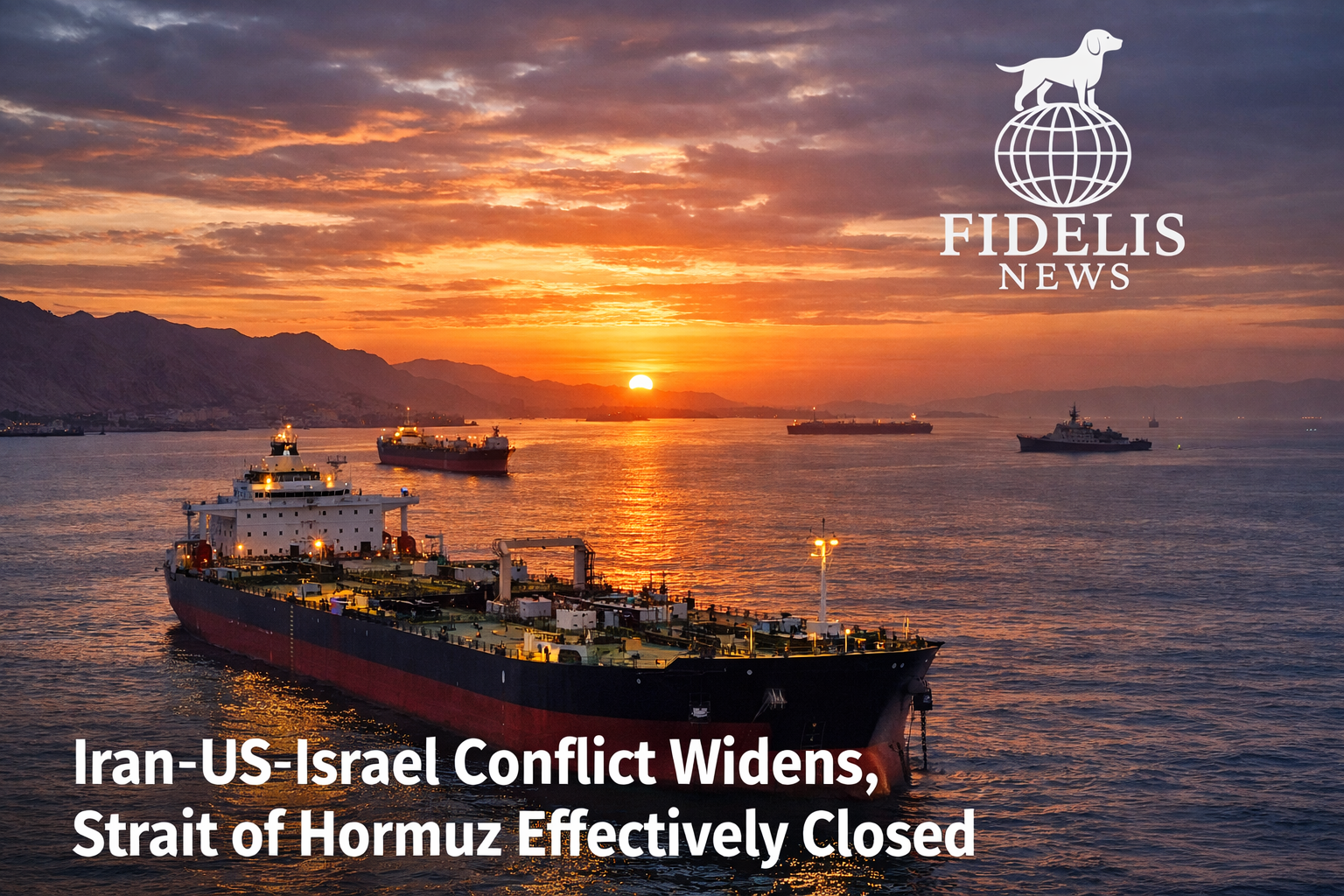
Strait of Hormuz on Edge: Iran–US–Israel Conflict Expands Across the Gulf
By Fidelis News
03 March 2026
The conflict between Iran and the United States/Israel has entered a sustained escalation phase, widening beyond direct military exchanges into maritime disruption, proxy warfare, and regional diplomatic fallout.
While no major new offensive was confirmed in the most recent reporting window, operational tempo remains high. The most consequential development is the effective paralysis of shipping through the Strait of Hormuz — a chokepoint through which roughly one‑fifth of global oil supply normally transits.
What’s Happening Now
U.S. and Israeli air operations continue against Iranian military infrastructure, including air defenses and command nodes.
Iran and Iran‑aligned forces continue missile and drone retaliation across Israel and Gulf states hosting U.S. forces.
Iran has declared the Strait of Hormuz closed and warned vessels against transit, though U.S. officials dispute the legal status of that claim.
Maritime insurers have withdrawn or suspended war‑risk coverage for Gulf routes, causing commercial tanker traffic to collapse.
Even without a universally recognized legal blockade, the effect is the same: shipping has slowed to a near halt as companies avoid the risk.
How We Got Here
28 February 2026
A coordinated U.S.–Israeli strike campaign began inside Iran, targeting senior leadership and strategic military infrastructure. Iranian state media later confirmed the death of Supreme Leader Ali Khamenei during the initial strike phase.
1 March 2026
Iran launched widespread missile and drone retaliation against Israeli territory and U.S. installations across the Gulf. Hezbollah opened a northern front from Lebanon, firing rockets and drones into Israel, prompting Israeli strikes in southern Lebanon and Beirut‑area targets.
2 March 2026
Iran declared the Strait of Hormuz closed and threatened action against vessels attempting to transit. Maritime insurers withdrew coverage for Gulf transits, and commercial tanker traffic sharply declined. Western governments issued evacuation advisories and began drawing down non‑essential personnel.
3 March 2026
Sustained air operations and retaliatory strikes continue across multiple theaters. Regional governments are escalating diplomatically while preparing defensive measures.
What Is Confirmed — and What Is Not
Confirmed:
U.S.–Israeli strikes inside Iran are ongoing.
Iranian missile and drone retaliation is active across Israel and parts of the Gulf.
Hezbollah is engaged along Israel’s northern border.
Commercial shipping through the Strait of Hormuz is effectively disrupted due to risk and insurance withdrawal.
Western evacuation advisories and partial diplomatic drawdowns are underway.
Unconfirmed or Disputed:
The legal status of the Strait of Hormuz closure under international maritime law remains contested.
Precise casualty figures across combatant and civilian populations are still evolving.
Some claims of specific infrastructure destruction or high‑value military losses lack independent verification.
Why the Strait of Hormuz Matters
The maritime domain is now the most strategically sensitive front.
If Iran moves from threat to enforcement — through interdictions, vessel seizures, or sustained attacks on commercial shipping — the conflict would shift from regional war with economic spillover to a structural global energy crisis.
The next signals to watch include:
Direct attacks on neutral or non‑military commercial vessels.
Confrontations between Iranian naval elements and Western escort forces.
Announcements of multinational convoy operations.
Sustained rerouting of shipping around Africa.
Oil and gas markets are already reacting to risk premiums. A prolonged disruption would intensify inflationary pressure worldwide.
Could Europe Be Drawn In?
For now, the UK and EU posture remains defensive and diplomatic. Governments have emphasized restraint, evacuation planning, and civilian protection.
Escalation markers would include:
Deployment of UK or EU naval assets specifically tasked with escorting commercial shipping in the Gulf.
Expanded rules of engagement authorizing protective maritime action.
Formal collective security commitments tied to Gulf shipping.
A shift from diplomatic caution to active maritime security operations would significantly widen the coalition footprint of the conflict.
The Bigger Picture
This is no longer a limited punitive exchange.
The conflict now spans:
Air campaigns inside Iran
Proxy warfare in Lebanon
Missile and drone exchanges across the Gulf
Diplomatic escalation among regional powers
Economic pressure through maritime disruption
The decisive inflection point may not come from the skies, but from the sea.
If shipping interdiction becomes sustained and kinetic, the global economic consequences could outpace the military confrontation itself.
For now, containment remains possible — but the margin is narrowing.
Fidelis is independent and reader-supported. If you value clear, sober analysis in an era of noise, consider supporting our work.