
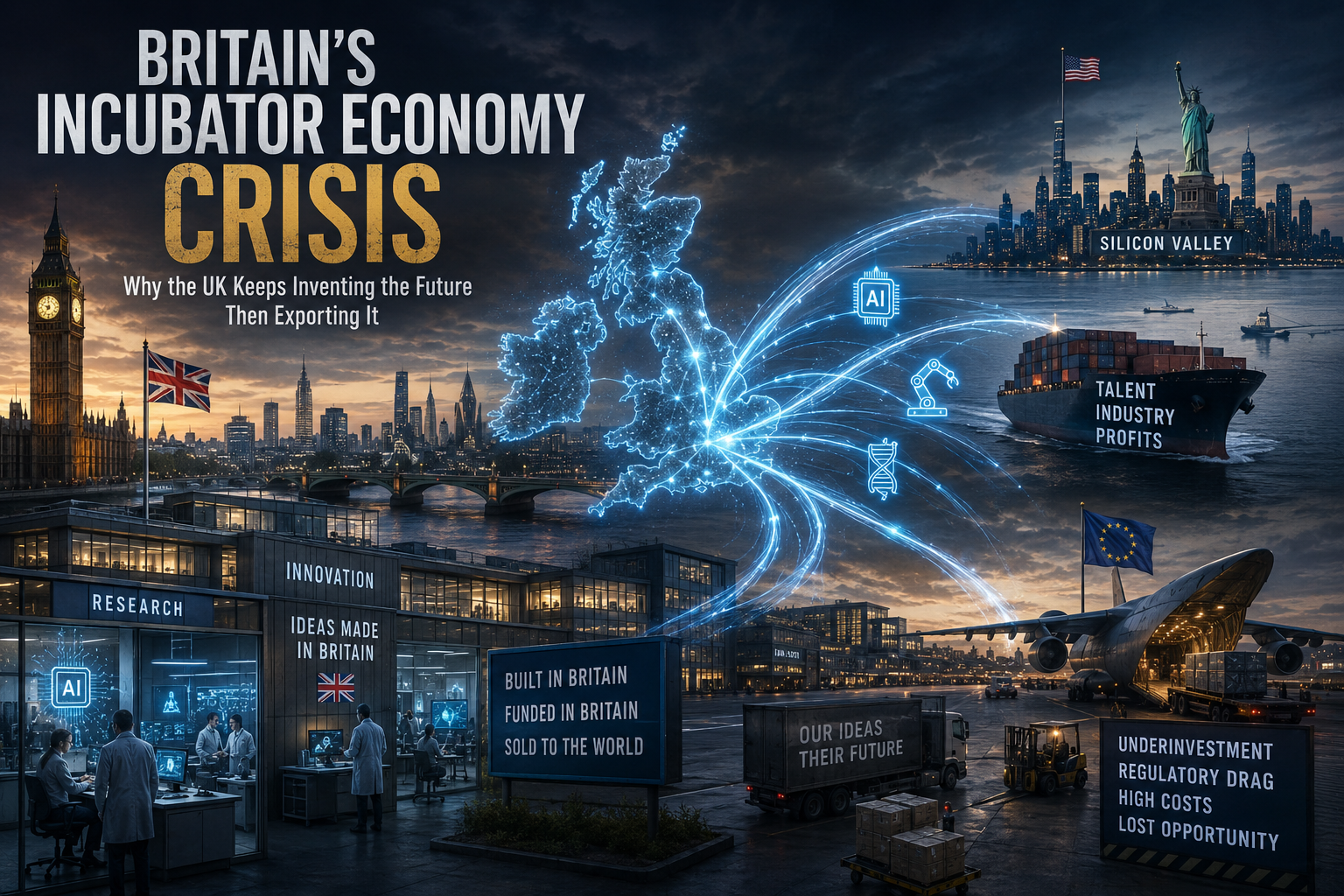
Britain’s “Incubator Economy” Crisis: Why the UK Keeps Inventing the Future Then Exporting It
Britain still produces world-class science. The problem is that the profits, companies, and strategic leverage increasingly end up somewhere else.
A growing number of economists, technology leaders, and parliamentary committees are warning that the United Kingdom has developed a dangerous economic pattern: invent domestically, scale internationally, lose control locally.
The issue is no longer being framed as a temporary weakness or a market inefficiency. Increasingly, it is being described as a structural national vulnerability.
A recent House of Lords Science and Technology Committee report warned that Britain’s failure to retain and scale science and technology firms has reached “crisis point,” arguing that the UK economy is effectively “bleeding out” as high-growth firms move overseas for investment, manufacturing, and expansion.
The warning comes at a time when the British government is simultaneously promoting artificial intelligence, defence technology, advanced manufacturing, quantum computing, and biotechnology as central pillars of future economic growth.
The contradiction is becoming difficult to ignore.
Britain continues to produce elite research, strong universities, and globally respected technical talent. Yet many of the companies built from that ecosystem ultimately relocate significant operations abroad, particularly to the United States.
The UK develops the intellectual capital.
Other nations often capture the industrial power.
The “Incubator Economy” Problem
The Lords Committee used unusually direct language in its assessment, warning that Britain risks becoming an “incubator economy” where promising firms are created domestically before leaving for larger markets and deeper capital pools overseas.
This is not a new phenomenon.
For years, British startups and scale-ups have cited the same pressures:
- Limited late-stage investment capital
- Regulatory uncertainty
- Weak industrial strategy continuity
- High energy costs
- Planning constraints
- Slow procurement systems
- More aggressive US investment environments
The result is a repeated cycle where Britain trains the talent, supports the research phase, and absorbs much of the early risk, only for the long-term economic returns to migrate elsewhere.
That matters far beyond simple GDP figures.
Modern geopolitical power increasingly depends on control of advanced technology ecosystems: AI infrastructure, semiconductor supply chains, aerospace systems, biotech, cyber capability, robotics, energy systems, and defence manufacturing.
Losing ownership of these sectors does not simply reduce profits.
It reduces national leverage.
AI, Defence, and the New Sovereignty Question
The debate is becoming sharper because many of the technologies involved are no longer merely commercial.
They are strategic.
Across Europe, governments are now openly discussing “technology sovereignty” and “defence sovereignty” as Russia’s war in Ukraine reshapes military and industrial planning.
Low-cost drones, autonomous systems, AI-enabled cyber operations, and rapidly adaptable manufacturing have exposed how quickly technological advantages can alter military realities.
At the same time, Britain is attempting to position itself as a leading AI power.
Government-backed initiatives around AI infrastructure, quantum computing, cybersecurity, and digital regulation are accelerating.
But critics argue that Britain still lacks the deeper industrial framework required to convert scientific leadership into durable sovereign capability.
The concern is straightforward:
If Britain invents the next generation of critical technologies but foreign firms own the infrastructure, data, compute power, manufacturing, and deployment pipelines, then the UK may retain prestige while losing practical control.
The Capital Gap
One of the most persistent issues identified by analysts is investment scale.
Britain performs relatively well at early-stage startup creation but struggles badly at later growth phases where companies require major capital injections to expand globally.
The House of Lords report specifically warned that British pension funds and institutional investors allocate too little capital into domestic high-growth science and technology firms compared to the United States.
That creates a predictable outcome.
Companies seeking serious expansion capital often look abroad.
Once that happens, headquarters, manufacturing, taxation, intellectual property ownership, and strategic decision-making frequently follow.
Recent polling from techUK suggests many British firms are already considering international relocation or overseas expansion due to frustration with domestic growth conditions.
The problem is compounded by broader economic instability.
Britain faces slowing growth, weak productivity, rising debt pressures, and increasing political fragmentation.
For investors, uncertainty itself becomes a risk multiplier.
Britain’s Underlying Strength Still Exists
Despite the warnings, Britain retains significant advantages.
The UK remains one of the world’s strongest research environments and continues to produce globally competitive scientific work.
British universities remain deeply influential in fields including AI, pharmaceuticals, materials science, aerospace, defence research, and biotechnology.
London continues to attract financial and international talent.
The challenge is less about invention itself and more about retention.
The danger is not immediate collapse.
It is gradual extraction.
A slow transfer of capability, ownership, and industrial depth away from the country over time.
The Strategic Question
At its core, this debate is no longer purely economic.
It is civilisational.
Can Britain remain a genuinely sovereign technological and industrial power in the 21st century, or will it become a research and talent feeder system for larger economic blocs?
That question now sits underneath almost every major national conversation:
AI.
Energy.
Defence.
Cybersecurity.
Manufacturing.
Immigration.
Education.
Infrastructure.
Scientific breakthroughs alone are not enough.
Without the industrial systems to retain and scale them, innovation becomes another export.
And eventually, so does influence.
Fidelis is independent and reader-supported.
If you value long-form reporting focused on truth, sovereignty, technology, and systemic risk, consider supporting our work.
☕ Support Fidelis via Buy Me a Coffee:
https://buymeacoffee.com/fidelisnews
Fidelis: For Those Who Still Value Truth